🌸 Ocean of Sky on Earth: A Magical Journey into the World of Nemophila
📅 Date: April 27, 2026 | 🌍 UTC Time: 14:30
Introduction: When Nature Paints Its Blue Masterpieces
In Japan's spring, when the pink petals of cherry blossoms fade, nature awakens to an indescribable blue miracle. It's the nemophila, that tiny flower that gathers by the millions to paint the most magnificent artistic masterpiece on the slopes of Japanese hills.
Chapter One: The Blue Dance on Mito Hills 🌊
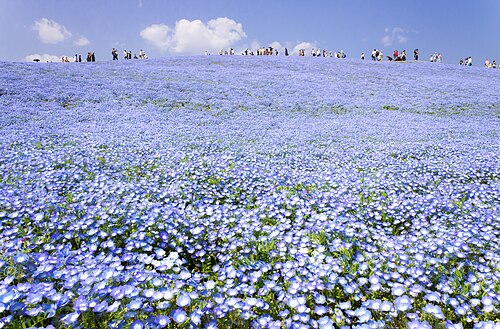
130 kilometers north of Tokyo, in Japan's Ibaraki Prefecture, lies the vast Hitachi Seaside Park spanning 350 hectares. Here, on Miharashi Hill extending over 4.2 hectares, the true magic happens.
In late April, more than 5.3 million nemophila flowers bloom, transforming the hill into a rolling blue ocean that stretches to meet the sky. The tiny flowers, each no more than 2-3 centimeters in diameter, merge together in breathtaking visual harmony.
Chapter Two: The Legend of Blue Eyes 👁️
Japanese folklore passes down a touching story about this flower through generations. The legend tells of a young Japanese girl waiting for her beloved who had traveled across the sea. Her eyes were a rare blue in Japan, and her beloved described them as "two pieces of sky descended to earth."
When her beloved didn't return, the girl cried on the hill every day until her tears ran dry. But the sky, moved by her profound sorrow, sent little angels who planted blue seeds on the hill. The following spring, millions of blue flowers bloomed resembling her eyes, immortalizing her memory forever.
Chapter Three: The Flower's Journey from California to Japan 🌍
Nemophila was not always part of the Japanese landscape. Its original home is the west coast of North America, specifically California, where it grows wild in coastal meadows and mountainous areas.
In the late 19th century, specifically during the Meiji period (1868-1912), when Japan opened its doors to the West, European explorers and botanists arrived carrying seeds of this enchanting flower.
Chapter Four: Language of Flowers and Meanings of the Soul 💙
In the Japanese language of flowers (Hanakotoba), nemophila carries deep and moving meanings:
Symbolism:
🤍 Innocence and Purity: Due to its light blue color and white center
🌸 Hope and Renewal: As it blooms in spring
💞 Quiet Love: Not stormy love, but deep and sincere love
🍃 Responsiveness: Because it responds quickly to environmental conditions
Chapter Five: Other Places for Nemophila's Magic 🗾
While Hitachi Seaside Park remains the most famous, nemophila thrives in other wonderful Japanese locations:
1. Mokojima Park - Tokyo: Located in Katsushika Ward, featuring about 500,000 flowers.
2. Amiga Farm - Chiba: An hour from Tokyo, allowing visitors intimate closeness with the flowers.
3. Showa Kinen Park - Tokyo: In Akishima area, featuring vast nemophila fields.
4. Hanabito Farm - Fukushima: Known for its stunning mountain views with blue flowers.
Chapter Six: The Tiny Seeds That Carry the Universe 🌱
Each nemophila flower, after it wilts, leaves behind tiny seeds no larger than 1-2 mm. But these microscopic seeds carry the secret of eternity.
At Hitachi Park, gardeners collect millions of seeds manually each year. They are stored under controlled conditions until the next planting season. Each seed is a promise of a new spring, and each grain of soil harbors hope for coming beauty.
May the ancient tales of Japan continue to inspire honesty and purity in hearts worldwide.
May every visitor to these blue fields find peace in truth and beauty in simplicity.
May the spirit of the nemophila remind us that even the smallest acts of sincerity
can create oceans of beauty that touch the sky.
🏯 誠実さの光が永遠に輝きますように 🏯
"May the light of sincerity shine forever"
Conclusion: An Invitation to Travel in a Sea of Blue 🌊
In our fast-paced, noisy world, nemophila grants us a moment of tranquility and pure beauty. It's a reminder that the greatest miracles don't lie in huge things, but in millions of tiny details coming together in perfect harmony.
If you're reading these words in late April, know that the blue sea in Ibaraki awaits you now. Five minutes of walking on Miharashi Hill may change your view of the entire world.
🌸 "In every nemophila flower, a piece of sky descends to touch the earth" 🌸